Verified Credentials
Request the active Arizona Registrar of Contractors license number and verify its standing. Review the current bond, general liability, and workers' compensation certificates instead of relying on a verbal assurance.
Choosing a residential asphalt paving contractor in Tempe starts with questions about credentials, scope, materials, drainage, compaction, cost, and warranty. Tempe Asphalt uses these same questions during estimates because desert soil movement and monsoon runoff can expose weak base preparation quickly. Clear written answers let you compare bids before equipment arrives.
Request the active Arizona Registrar of Contractors license number and verify its standing. Review the current bond, general liability, and workers' compensation certificates instead of relying on a verbal assurance.
Ask for the exact asphalt mix, aggregate, binder, lift thickness, base-preparation method, and density target. The contractor should also explain how drainage and Tempe's expansive desert soils affect grading and base repair.
Make the quote identify demolition, base work, drainage correction, paving, haul-off, and any striping or sealant work that applies. Confirm the schedule and a payment structure with a modest deposit, a progress payment after base preparation, and final payment after inspection.
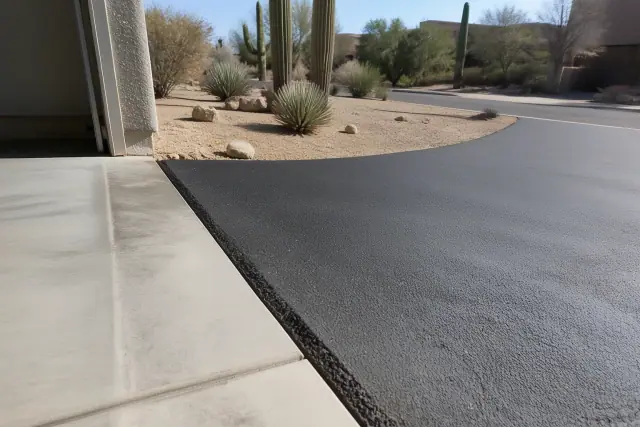
A written proposal that separates demolition, base repair, drainage correction, paving, and haul-off. This makes hidden exclusions and possible added costs easier to compare.
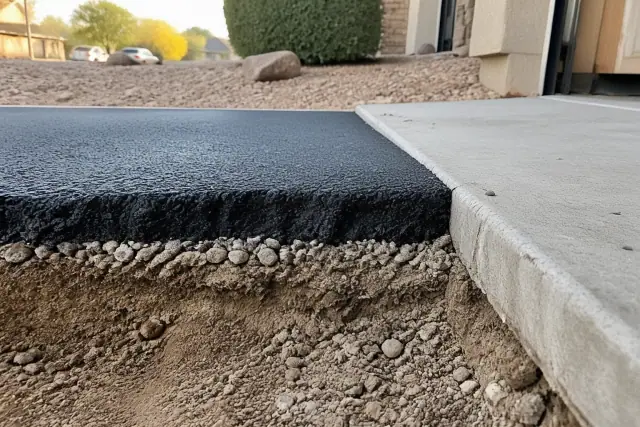
The compacted 4- to 6-inch aggregate base, roughly 2- to 3-inch asphalt surface, and drainage slope as distinct layers. This image helps make clear why base evaluation matters before paving.
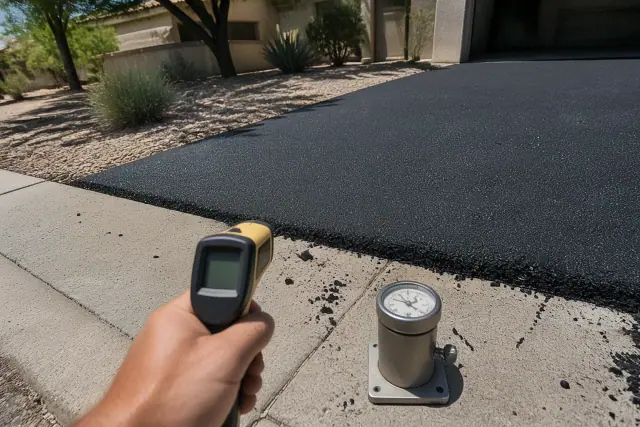
A crew checking mat temperature and recording compaction density while rolling. These measurements reveal whether the quality-control answer can be verified on-site.
Ask for similar driveway or parking-lot photos that are at least two to three years old, then call at least two Tempe or Maricopa County references about drainage and cracking. Fresh asphalt alone does not show long-term performance.
The proposal should name the binder grade, commonly used 3/8-inch or 3/4-inch aggregate, and any recycled asphalt pavement content. Arizona mixes may use up to 15 to 20 percent recycled asphalt pavement when designed to the applicable specifications.
Ask how the crew will reach 92 to 96 percent of maximum theoretical density while the mix remains workable. The draft's temperature range is roughly 300°F at lay-down and no lower than 185°F before compaction locks in.
Do not volunteer your maximum budget, accept a cash-today offer without a contract, or let paving begin before the base is evaluated. Pause if the contractor will not define the scope, warranty, change costs, or payment milestones in writing, or demands full payment upfront.
| Ask About | A Strong Written Answer Includes | Reason to Pause |
|---|---|---|
| Credentials | An active Arizona Registrar of Contractors license number, current bond, and insurance certificates. | Verbal assurances without documents. |
| Base and drainage | How the existing base will be evaluated, repaired, compacted, and graded for runoff. | Paving based on a surface look alone. |
| Mix and lift | The mix design, aggregate size, binder grade, recycled content, and compacted lift thickness. | No material or thickness specifications. |
| Quality control | The target density, rolling temperature window, and on-site verification method. | No measurable compaction standard. |
| Scope and payment | Demolition, base repair, drainage correction, haul-off, milestones, and final inspection. | A headline price or full payment upfront. |
Strong answers are specific enough to verify before the crew arrives. The proposal should connect the existing base and drainage to the chosen mix, lift thickness, density checks, schedule, traffic restrictions, and warranty. A typical residential replacement may require one to two days for demolition and base preparation plus one day for paving, weather permitting, so the contractor should explain how that sequence applies to your property.
Existing base condition, excavation depth, drainage, site access, project size, and residential or commercial loading can change both price and method. Residential asphalt installation commonly runs $7 to $13 per square foot, with labor around $1.15 per square foot and materials from $0.08 to $0.50 per square foot depending on mix; seal coating is typically $0.13 to $0.30 per square foot, while minor crack repair runs $1 to $3 per linear foot. Commercial lots may also require thicker sections, larger-area drainage grading, ADA-compliant striping and marking, and a clear answer about whether striping is performed in-house or subcontracted.
Homeowners often ask whether resurfacing is enough, how long new asphalt lasts, when they can use it, and what the warranty covers. A 1.5- to 2-inch overlay may work when the base is sound and cracking is surface-level; alligator cracking, potholes, or settling point to full-depth replacement. A properly installed asphalt driveway typically lasts 15 to 20 years, or up to 20 to 30 years with consistent maintenance that includes seal coating. Most fresh driveways can take foot traffic in 24 to 48 hours but need 3 to 5 days before vehicles park on the surface; get the exact traffic limits and workmanship warranty coverage for cracking, settling, and drainage in writing.
Bring the written questions, project dimensions, photos, and notes about drainage or cracking to your estimate. A local paving team can explain the base, mix, compaction, traffic limits, payment schedule, and warranty terms before you sign.