Proudly serving Tempe, Mesa, Chandler, Scottsdale, Gilbert & surrounding areasCall or Text 24/7: +1 (480) 571-0856

Asphalt Paving Installation, Overlays, and Pavement Repair in Tempe, AZ

Tempe Asphalt installs and repairs asphalt pavement for homes, commercial properties, and industrial sites in Tempe, Arizona. Our paving services include new driveways, parking lots, mill and overlay resurfacing, crack sealing, pothole repair, chip seal, and sealcoat application. We scope each project around the property's soil, drainage, and expected traffic load. Call for a free paving quote after we walk the property and assess the existing conditions.

Tempe pavement faces summer surface temperatures that routinely climb past 140 degrees, followed by monsoon downpours every July and August. That heat and water cycle accelerates oxidation, cracking, rutting, and base failure. Pavement built over a poorly compacted base can develop alligator cracking within a decade. Correct grading, structural depth, and timely maintenance help the surface shed water and carry its intended loads.

Projects are built on compacted aggregate base course, typically 4 to 6 inches for residential work and up to 8 inches for commercial or industrial loads, before hot mix asphalt is placed and compacted to Maricopa Association of Governments specifications. Our crews are trained in ADOT-standard paving practices.

Tempe Asphalt provides asphalt paving throughout Tempe's 85281, 85282, 85283, and 85284 ZIP codes and nearby Mesa, Chandler, Scottsdale, and Guadalupe.

★ ★ ★ ★ ★4.9/5 Average Rating · 20+ Years of Experience · Thousands of Customers Helped · Licensed & Insured · Residential & Commercial
Asphalt Paving Options & Benefits

What Is Asphalt Paving?

Asphalt paving is a layered pavement system, not just a black surface. A compacted aggregate base supports hot mix asphalt, while the finished grade directs water away from garages, foundations, curbs, and drain inlets.

The structural section should match the property's soil, drainage patterns, and vehicle loads. A passenger-vehicle driveway, a retail lot with delivery traffic, and a warehouse route used by loaded semis require different base and asphalt depths.

New installation is appropriate when no usable pavement structure exists or the base has failed. When the base remains sound, an overlay, mill and overlay, localized patch, crack seal, or sealcoat may restore or protect the surface with less reconstruction.

Benefits of Proper Asphalt Construction

A well-planned asphalt section balances drainage, load capacity, surface finish, and maintainability. The result is pavement designed for the way a Tempe property is actually used.

  • Positive drainage that limits water intrusion into the base
  • Structural depth matched to cars, trucks, RVs, trailers, or semis
  • A smooth, compacted surface for driveways and parking areas
  • Repair options that target isolated failures before replacement
  • Resurfacing choices that retain a structurally sound base
  • Sealcoat protection against UV exposure, oil, and water
  • Crack sealing that blocks a common path to base saturation
  • Traffic markings suited to commercial circulation and access
Paving and Pavement Care

Tempe Asphalt Paving Services

Our paving work covers new construction, surface renewal, preventive maintenance, and localized repair. Each recommendation starts with the condition of the base and drainage so an overlay or patch is not used where reconstruction is needed.

New Asphalt Driveway Installation

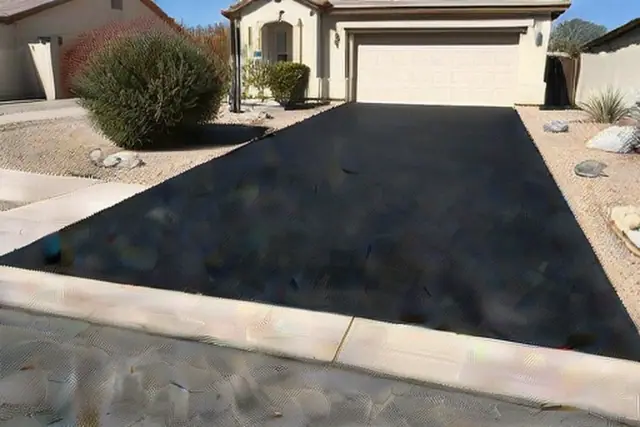
Freshly paved black asphalt driveway with clean edges at a home in Tempe, AZ.

A new driveway begins by removing 6 to 8 inches of soil and old material, installing compacted aggregate, and grading for positive drainage. We then place and compact 2 to 3 inches of hot mix asphalt: 2 inches is generally adequate for passenger vehicles, while properties that regularly park trucks, RVs, or trailers may need 3 inches. The same process can serve a single-car driveway or shared paved access for a multi-unit property.

Request Estimate

Commercial Parking Lot Paving

Commercial parking lot paving in Tempe, AZ

Commercial lots are designed around delivery traffic, customer circulation, drainage, and ADA-compliant striping. A typical commercial section uses 3 to 4 inches of asphalt over an engineered base. Small lots often run $3.50 to $6.50 per square foot, placing a 4,000 to 8,000 square foot project between $14,000 and $52,000 depending on base depth, drainage structures, access, and striping scope.

Request Estimate

Asphalt Resurfacing and Mill & Overlay

Asphalt resurfacing and mill & overlay in Tempe, AZ

An overlay adds 1.5 to 2 inches of hot mix over a prepared surface when the base remains sound. Mill and overlay first removes the top 1.5 to 2 inches so new asphalt can be placed at the original grade near curbs, drains, and thresholds. The City of Tempe uses this milling and compaction approach in road improvements scheduled citywide through 2028, and we apply the same basic approach on private lots and residential streets.

Request Estimate

Asphalt Sealcoating

Asphalt sealcoating in Tempe, AZ

Two coats of coal tar or asphalt emulsion-based sealer help block UV rays, oil drips, and water while the surface remains closed to traffic for 24 to 48 hours. New asphalt should cure 60 to 90 days before its first sealcoat. Reapplication is generally recommended every 2 to 3 years for residential driveways and annually for high-traffic commercial lots; consistent sealcoat and crack care can extend use past 20 years, while neglected lots may need resurfacing within 10 to 12 years.

Request Estimate

Crack Sealing, Pothole Repair, and Patching

Crack sealing, pothole repair, and patching in Tempe, AZ

Cracks are routed and filled with hot-applied rubberized sealant so the material can bond and flex with the pavement. Left open, a quarter-inch crack can become structural damage within one or two monsoon seasons. A structurally isolated pothole is usually a same-day fix: we square the edges, remove failed material to solid base, and compact hot mix in lifts to reduce settling within the first year; localized patches can extend the surrounding driveway's life by several years.

Request Estimate

Chip Seal and Line Striping

Chip seal and line striping in Tempe, AZ

Chip seal offers a durable, lower-cost wearing surface for lower-traffic municipal and residential roads. New and resurfaced commercial lots can be restriped with accessible spaces, van-accessible aisles, fire lanes, and directional arrows using reflective traffic paint rated for Arizona UV exposure.

Request Estimate
Pavement by Property and Condition

Types of Asphalt Paving Options

The right paving option depends on who uses the surface, how much weight it carries, whether the base is stable, and how water leaves the site. These property and condition categories guide the structural section and repair method.

Residential driveway paving in Tempe, AZ

Residential Driveway Paving

Residential paving serves driveways and shared access near Papago Park, south of Broadway Road, and in neighborhoods such as Escalante and Hudson Manor. UV oxidation can produce surface cracks in as little as 5 to 7 years on an unmaintained driveway, compared with the 20 to 30 year potential of a properly built and maintained surface.

  • New driveway excavation and installation
  • Positive slope toward the street instead of the garage slab
  • Passenger-vehicle and heavier parking-load designs
  • Residential pricing of roughly $3.00 to $5.50 per square foot
  • Typical 500 to 800 square foot driveways ranging from $1,500 to $4,400
Request Estimate
Commercial parking surfaces in Tempe, AZ

Commercial Parking Surfaces

Retail centers, office parks, multi-tenant properties, and dense student housing near Arizona State University need pavement suited to delivery trucks and frequent turnover. Along Rural Road and Mill Avenue, the design also accounts for striping, fire-lane access, drain structures, and water movement away from foundations.

  • Engineered base matched to daily vehicle loads
  • Parking-lot installation and resurfacing
  • Rutting and alligator-crack assessment
  • Accessible spaces, aisles, arrows, and fire lanes
  • Drainage planning for monsoon downpours
Request Estimate
Industrial and municipal paving in Tempe, AZ

Industrial and Municipal Paving

Warehouses and distribution sites near Loop 101, Priest Drive, and Kyrene Road carry heavier axle loads than ordinary commercial lots. These sites often use 5 to 6 inches of asphalt and a thicker structural section coordinated with property engineers.

  • Warehouse and distribution-site paving
  • Structural sections for heavy axle loads
  • Engineer coordination on load requirements
  • Drainage planning around docks and traffic routes
  • Chip seal for appropriate lower-traffic roads
Request Estimate
Overlay and mill And Overlay renewal in Tempe, AZ

Overlay and Mill-and-Overlay Renewal

Resurfacing renews a failed or worn surface without unnecessary full-depth reconstruction when the base is stable. The choice between a direct overlay and milling depends on cracking, rutting, drainage, and available elevation at fixed features.

  • Base-integrity inspection before resurfacing
  • Direct overlay where added elevation is acceptable
  • Milling where the original grade must be retained
  • Preparation around drains, curbs, and thresholds
  • New hot mix compacted over the prepared surface
Request Estimate
Preventive pavement maintenance in Tempe, AZ

Preventive Pavement Maintenance

Crack sealing and sealcoat application slow the surface damage caused by sunlight, vehicle fluids, and water infiltration. Maintenance is most useful while the pavement and base remain structurally sound.

  • Routine inspection for opening cracks
  • Rubberized crack seal that flexes with the pavement
  • Sealcoat coverage for UV, oil, and water exposure
  • Targeted patches for isolated failure
  • Resurfacing review when damage extends beyond maintenance
Request Estimate
Finding the Right Fit

Choosing the Right Asphalt Paving Approach

The right approach follows the evidence on site: stable pavement may need preventive care, isolated defects may be patched, a sound base may support resurfacing, and structural failure calls for excavation and rebuilding. We evaluate soil, drainage, traffic, surface distress, and fixed elevations before recommending a scope.

Asphalt-Only Paving Focus

Asphalt paving is the work our crews perform rather than a trade handed to a general-purpose subcontractor. That focus carries through excavation, base preparation, hot mix placement, compaction, repair, resurfacing, and maintenance.

Site-Specific Paving Plan

No two properties carry the same traffic or move water the same way. We walk the site and account for soil type, drainage patterns, existing base condition, vehicle loads, equipment access, and striping needs before preparing a quote.

Commercial Paving Credentials

For commercial paving work, Tempe Asphalt carries the licensing, bonding, and insurance required by the Arizona Registrar of Contractors. Crews follow ADOT-standard practices and compact hot mix to applicable Maricopa Association of Governments specifications.

What Sets Our Work Apart

Why Choose Us for Asphalt Paving Work?

A durable paving scope starts below the surface. Tempe Asphalt pairs asphalt-focused work with property-specific evaluation, drainage planning, load-based structural depth, and a clear comparison of repair, resurfacing, and replacement options before you commit.

Get a Free Paving Quote

Alligator Cracking

Interconnected cracks often point to repeated loading over a weakened or saturated base rather than a surface-only defect. We assess how much area is affected and whether the support below it must be rebuilt before new asphalt is placed.

Potholes

Potholes develop where asphalt and the supporting material have broken away. A durable patch removes loose material to a solid base, creates clean edges, and restores the section in compacted lifts instead of filling only the visible depression.

Wheel-Path Rutting

Ruts form where repeated wheel loads deform the surface or underlying section. Their depth and extent help determine whether localized work, milling, full-depth reclamation, or reconstruction is the appropriate response.

Raveling and Edge Failure

UV oxidation can dry the binder until aggregate loosens and the surface begins to ravel. Unsupported driveway edges may also crumble under traffic, so repairs need to match the original section depth and avoid creating a low spot.

Standing Water

Ponding lets water work through cracks and saturate the aggregate base, accelerating failure. The repair plan must address slope, drains, or the source of the low area so water does not keep collecting against pavement or a building foundation.

Weak Base and Soft Spots

Chronic soft spots usually trace back to poor drainage, weak material, or inadequate compaction below the asphalt. We excavate the failed area, correct the cause, rebuild the base, and then patch; covering the surface alone can bring the same failure back next year.

How It Works

Our Asphalt Paving Process

Every scope begins with the property and ends with the pavement's intended use. The steps adjust for a new installation, overlay, mill and overlay, or localized repair, but base support, drainage, placement, and compaction remain central.

01.

Walk the Site and Inspect

We review surface distress, drainage patterns, base condition, traffic loads, thresholds, curbs, and equipment access. That site walk determines whether the property needs installation, resurfacing, maintenance, or targeted repair.

02.

Excavate or Mill as Needed

New construction and failed sections are excavated to the planned depth. Resurfacing may instead require cleaning and preparation or milling the worn surface where final elevation must remain unchanged.

03.

Build the Base and Grade

Aggregate base is installed and compacted for support. The grade is shaped for positive drainage toward the intended outlet rather than toward garages, foundations, or low areas.

04.

Place Hot Mix Asphalt

Hot mix asphalt is placed at the depth selected for the property's traffic and structural needs. Areas around edges, utility features, curb lines, drain inlets, and transitions are formed to support drainage and a clean finish.

05.

Compact and Finish

The asphalt is compacted in lifts with a vibratory roller to reach the specified density. Commercial work is then finished with the required accessible markings, fire lanes, arrows, and parking layout.

06.

Plan Surface Care

After the surface is ready for use, maintenance focuses on keeping cracks sealed, correcting drainage issues early, and applying sealcoat on the appropriate schedule. Early attention helps prevent surface damage from progressing into the base.

Start With a Site Walk

Request an Asphalt
Paving
Quote

Tell us whether you are planning a driveway, parking lot, industrial surface, repair, resurfacing, or maintenance project. We will walk the property, review the base and drainage conditions, and provide a free paving quote suited to the site.

Paving Help

Asphalt Paving FAQs

These answers cover driveway installation, parking-lot work, overlays, repairs, maintenance, pricing, and private-versus-public pavement service in Tempe.

Call Our Paving Crew

Yes, when the existing base is still sound, an asphalt overlay can place new hot mix over the prepared surface. If the pavement has widespread cracking, shifting, or structural base failure, those defects can telegraph through the overlay within a season or two, so a tear-out or deeper repair may be the better investment.

The process starts with excavation, followed by compacted aggregate base graded for positive drainage. Hot mix asphalt is then placed at the planned depth and compacted in lifts with a vibratory roller; getting the grade and base right is as important as the surface itself. A driveway that pools water against the foundation can undermine the base within a couple of years.

Tempe 311 is the city's non-emergency service line for reporting public-street potholes, drainage issues, and other municipal concerns. Those reports support the Pavement Management Program, which collects condition data every three years; private driveways and parking lots are handled by paving contractors rather than the city.

Cost depends on square footage, base condition, drainage, milling, pavement depth, striping, and equipment access. Statewide asphalt installation averages $3.33 per square foot, with a range of $2.60 to $4.05, but a property walk is needed to compare the actual cost of repair, overlay, or full replacement.

Cracks should be sealed as they open so monsoon water has less opportunity to reach the base. Residential surfaces generally need sealcoat every 2 to 3 years, while high-traffic commercial lots may need annual application because of constant sunlight, traffic, and vehicle fluids.

A standard passenger-vehicle driveway generally uses 2 inches of compacted hot mix asphalt over a properly prepared aggregate base. Where trucks, RVs, or trailers park regularly, 3 inches may be appropriate, subject to the site's soil, drainage, and base conditions.

The structural section is sized around expected cars, delivery trucks, or loaded semis rather than using one standard depth for every property. The design also accounts for an engineered base, drainage structures, traffic flow, and the required parking and access markings.

A direct overlay places new asphalt over a cleaned and prepared existing surface, which raises the final elevation. Mill and overlay removes the worn top layer first, allowing the replacement surface to return to the original grade near curbs, drain inlets, and door thresholds.

New asphalt needs time for volatile oils to leave the mix before sealer is applied. The recommended waiting period is 60 to 90 days, after which the surface can receive its first sealcoat.

Routing gives hot-applied rubberized sealant a better bonding surface and room to flex as the pavement moves. Sealing the opening helps keep water from reaching and saturating the aggregate base, where a surface crack can turn into structural failure.

The failed area is cut to clean edges and removed down to solid supporting material. New hot mix is placed and compacted in lifts to match the original section depth, while recurring soft spots require correction of the drainage or base problem beneath them.

New and resurfaced commercial projects include restriping to current ADA standards. The scope can cover accessible spaces, van-accessible aisles, fire lanes, directional arrows, and reflective traffic paint rated for Arizona UV exposure so markings do not fade to illegible within a year.

Tempe Asphalt serves residential, commercial, and industrial properties throughout Tempe and the surrounding East Valley. The service area includes Mesa, Chandler, Scottsdale, and Guadalupe.