2 Inches for Passenger Cars
Two inches compacted is the common minimum for a driveway used by sedans and light crossovers, provided the base is adequate and drainage is correct.
For most Tempe homes, Tempe Asphalt recommends 3 inches of compacted asphalt over a properly prepared base; 2 inches can work for passenger-car-only use. The extra inch matters when SUVs, pickups, RVs, or repeated delivery vehicles add concentrated loads. Base depth, drainage, and summer pavement temperatures above 140 to 150 degrees Fahrenheit can be just as important as asphalt depth.
Two inches compacted is the common minimum for a driveway used by sedans and light crossovers, provided the base is adequate and drainage is correct.
Three inches compacted better distributes loads from SUVs, pickup trucks, RVs, trailers, and delivery vehicles while improving resistance to rutting and reflective cracking.
Neither thickness performs well over a weak, wet, or poorly graded subbase; soil movement and standing water may call for more preparation before paving.
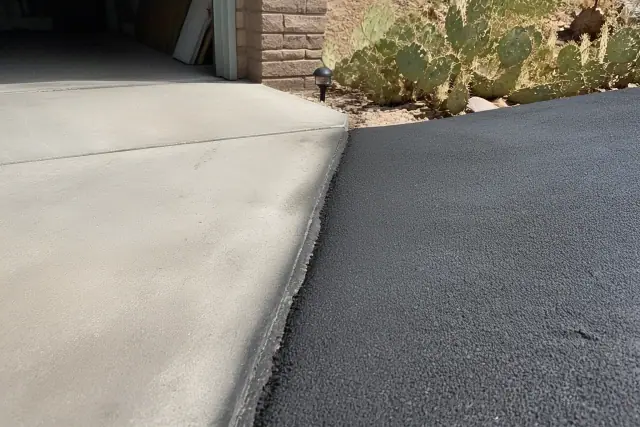
A compacted 2-inch wearing course above a properly graded aggregate base on a residential driveway used by passenger cars.
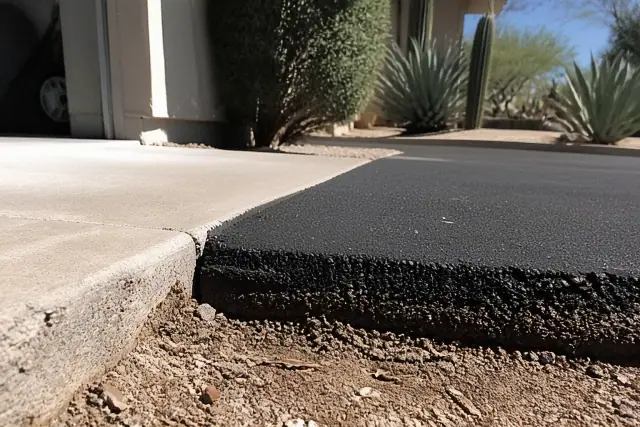
Separate 1.5-inch base and wearing-course lifts after compaction, with a heavier vehicle above the finished surface.
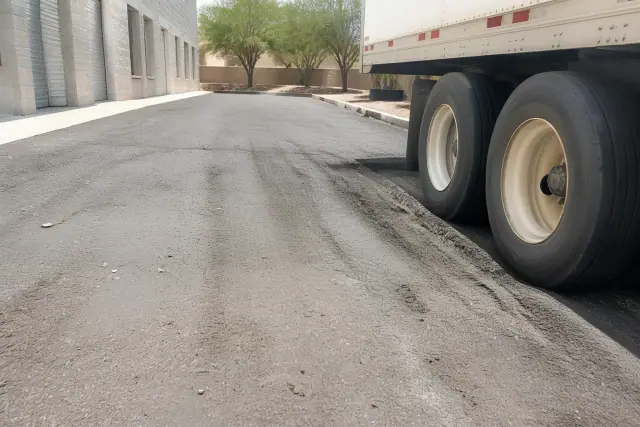
Tire-path rutting on a thin driveway during intense Tempe summer heat so the load-and-temperature risk is visually clear.
A driveway limited to sedans and light crossovers can perform well at 2 inches when the base is sound, compacted, and graded for drainage.
Choose 3 inches for regular heavy-vehicle use, long driveways with repeated deliveries, or properties where softer subgrade increases movement.
Tempe heat softens asphalt binder, while clay-influenced soils and monsoon moisture swings can move the subgrade, so drainage and base preparation remain critical.
Measure the finished compacted section after rolling, not the loose spread depth, or the installed pavement may be thinner than the quoted specification.
| Decision Factor | 2 Inches Compacted | 3 Inches Compacted |
|---|---|---|
| Typical use | Passenger cars and light crossovers | SUVs, pickups, RVs, trailers, or repeated deliveries |
| Placement | Single wearing course | Two 1.5-inch lifts: base and wearing course |
| Typical lifespan | 15 to 20 years with adequate base and maintenance | 25 to 30 years with proper subbase preparation |
| Tempe heat and rutting | Adequate for light loads but more vulnerable | Stronger resistance under concentrated loads |
Asphalt thickness is the compacted depth after rolling, not the loose mix spread by the crew. Loose asphalt compacts roughly 20 to 25 percent, so 3 inches of loose material may finish near 2.3 inches instead of the promised depth. A 2-inch driveway generally uses one wearing course; a 3-inch section is typically built in two lifts because compacting more than roughly 2 inches of loose mix in one pass can leave uneven density. Ask for the compacted asphalt thickness, base depth, and material tonnage in the written scope.
The answer changes with axle load, subgrade movement, drainage, and site access. Half-ton and three-quarter-ton trucks, RVs, trailers, and frequent delivery vehicles concentrate stress; a section below 2 inches can show rutting or cracking within 3 to 5 years under those loads. Tempe pavement surfaces can exceed 140 to 150 degrees Fahrenheit, while clay-influenced soils near Maple-Ash and south Tempe can move with August and September monsoon moisture, making a 4- to 6-inch compacted aggregate base especially important. Asphalt paving generally runs $3 to $7 per square foot, while projects with base work, milling, or drainage correction may run $7 to $13 per square foot. A typical 600- to 800-square-foot Tempe driveway is estimated at about $3,000 to $5,000 for 2 inches and $4,500 to $7,800 for a two-lift 3-inch installation; the longer service life can change the 20-year cost comparison.
Is 2 inches enough? It can be for sedans and light crossovers when the aggregate base is at least 4 inches thick and drainage is correct; routine sealcoating every 2 to 3 years plus prompt crack sealing supports the expected 15- to 20-year lifespan. Choose 3 inches when heavier vehicles, repeated delivery traffic, softer subgrade, or poor drainage increase stress. Maricopa County right-of-way work is separate from a private driveway; published industry data reports a 2.5-inch asphalt-concrete minimum over a 6-inch aggregate base and an at-least-5-inch total requirement, so the applicable section should be verified before work. If asphalt is too thin, excessive flex can lead to alligator cracking, ruts, and potholes; by contrast, concrete's typical 4-inch minimum is not a like-for-like comparison because concrete carries loads rigidly rather than flexibly.
Share the driveway size, vehicles, drainage concerns, and existing surface condition. A written estimate can identify compacted asphalt thickness, aggregate base depth, placement method, and material tonnage before work begins.